


How do you inspire someone to become curious about something they don’t yet know they care about?
I believe this is one of the most consequential questions facing civic education.
We devote considerable attention to what Americans should know about the Constitution, our history, and the institutions and principles of self-government. But even the best educational resources have limited reach and impact if we cannot first awaken the curiosity that motivates people to engage with them.
Before someone explores a constitutional question, visits a museum, or enrolls in a course, something must capture their interest. A person, experience, or encounter makes civic life relevant in a way it had not been before.
I think of these moments as civic sparks.
Understanding what makes them possible could transform how we approach civic learning. It would allow us to become more intentional about creating these opportunities, particularly in communities with thinner civic opportunity and infrastructure, connecting those initial moments of curiosity to experiences that deepen a person’s knowledge, interest, and engagement over a lifetime.
The spark begins the journey. What happens next determines how far it can take us.
The Stories Behind the Sparks
The National Constitution Center’s Civic Spark project grew out of a convergence between a comprehensive audience research study we undertook last year and my own experience with the lasting power of formative civic experiences.
As part of that research, we conducted qualitative interviews to understand Americans’ interests, experiences, and relationships to civic life. One finding was particularly compelling. People could recall, often with extraordinary clarity and emotion, the person, place, or moment that first awakened their civic curiosity. These were not simply stories about what people had learned. They were stories about what had made them want to learn more.
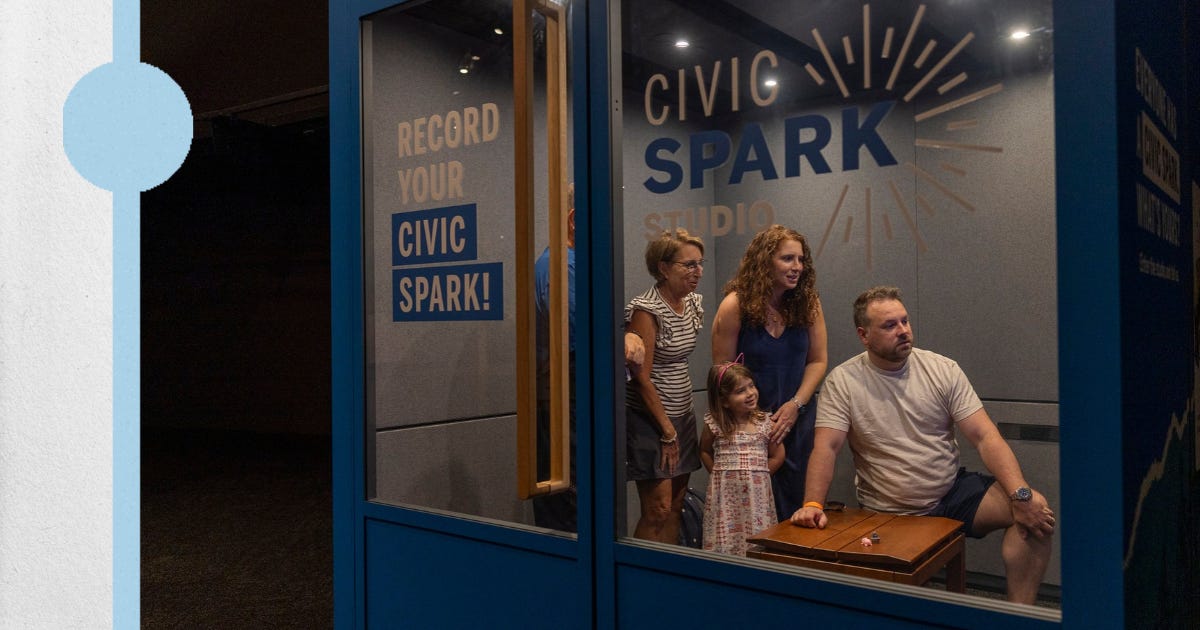
Informed by those findings and my own lifelong journey in civic learning, we launched the Civic Spark Studio, where museum visitors can record and share the experiences that shaped their civic identities. We’re also inviting people across the country to contribute their stories, with the ambition of gathering thousands of reflections on how civic curiosity begins.
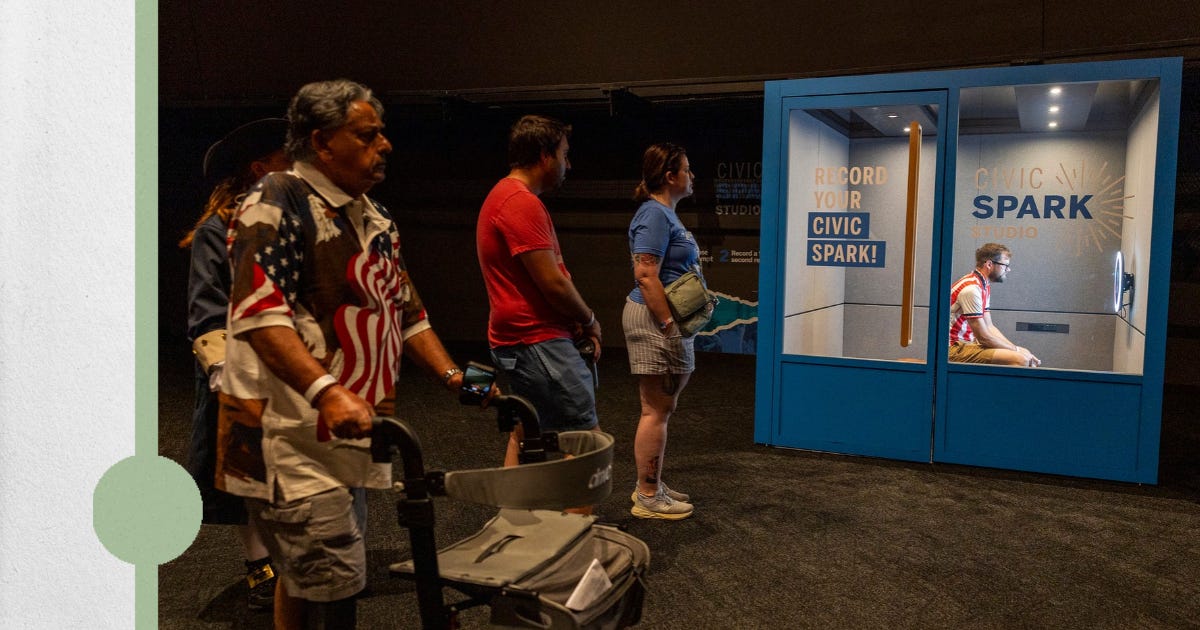
We’ve made sharing civic spark stories a regular activity at our meetings and convenings, inviting participants to reflect on their formative experiences and listen to those of others.
Last week, we did so with partners gathered in Philadelphia to explore the future of intergenerational civic learning. The stories were deeply personal and wonderfully varied, but several patterns emerged.
Many participants traced their earliest sparks to third or fourth grade. Some remembered a teacher who made history or government unexpectedly compelling. Others recalled a parent, grandparent, or caregiver who introduced a question or experience that captured their imagination. Subsequent encounters, often in museums, historic sites, or other community settings, reinforced their emerging interests.
Emotional resonance was another recurring theme. Some sparks came through joyful moments of discovery, connection, or accomplishment. Others emerged from moments of national consequence, including September 11, a pattern also reflected in our audience research and stories shared through the Civic Spark Studio. Though profoundly different, these experiences left an imprint, making civic life personally significant.
Sharing these stories has value in its own right. They invite people to reflect on their own connections to civic life and discover meaning in the experiences of others. But they are also generating a growing body of qualitative data that can inform how we design civic learning experiences that spark curiosity and open pathways to deeper learning and engagement.
Together, these stories are beginning to reveal several recurring elements: formative encounters that make civic life personally relevant; emotional resonance that leaves a lasting impression; relationships that nurture curiosity; and opportunities for continued discovery that allow an initial interest to deepen over time.
My own story offers a vivid illustration of how an initial civic spark, nurtured by subsequent experiences, can shape a lifetime of learning and engagement.
In fourth grade, a historic blizzard closed schools across southeastern Pennsylvania for nearly two weeks. My mother had exhausted her supply of activities to keep my siblings and me occupied. Concerned about how much school we were missing, she assigned each of us a letter of the alphabet and sent us to our family’s print encyclopedia set to choose a topic, learn about it, and return to deliver an oral report. My letter was “C.” I discovered and reported on the Constitution.
When school resumed, my teacher was beginning a unit on the three branches of government. Armed with my newfound knowledge, I could answer every question he posed. As a Type A, competitive fourth grader, I decided then and there that the Constitution was my calling and that I would devote the rest of my life to it.
That initial interest found new outlets. In eighth grade, I won the presidency of my social studies classroom during a government simulation. In 10th grade, a student leadership program introduced me to Nadine Strossen, then president of the American Civil Liberties Union, who spoke to our group about freedom of expression during wartime. Inspired by her lecture and the constitutional debates following September 11, I founded an ACLU student chapter at my high school. We met weekly to discuss questions surrounding civil liberties and national security. My interest in the First Amendment eventually became the subject of both my undergraduate thesis and my law school student note.
In law school, I helped transform a program that sent law students into K–12 classrooms to teach constitutional law into Constitutional Conversations, an intergenerational learning series at a local public library. We developed programs for middle school students, high school students, and adults, encouraging participants to continue exploring constitutional questions together beyond the sessions.
That experience changed my ambition. I entered law school intending to become a constitutional law professor. I left committed to making constitutional learning accessible to the broader public.
No one designed these experiences as a coordinated learning journey. Yet each built on what came before, introducing new questions, deepening my knowledge, and eventually inspiring me to create opportunities for others.
I recognize how extraordinary my journey was. I had a mother with the civic knowledge and resources to nurture my curiosity, opportunities for academic achievement, and dedicated mentors who encouraged me along the way. My path was shaped by circumstances that many people will never encounter. The goal is not to replicate my exact journey or expect others to reach the same destination, but to understand what made it possible: an initial spark, people who encouraged my curiosity, and successive opportunities that allowed my interests to deepen. By studying how these elements work together, we can create more opportunities for people to discover and pursue their own civic interests, wherever those journeys may lead.
What Makes a Spark Formative?
Across the growing qualitative dataset collected through the Civic Spark project, several patterns are emerging: developmental timing, emotional significance, meaningful relationships, and opportunities for continued discovery. We are only beginning to systematically analyze this evidence, but learning science offers clues about why these elements may matter.
Consider the frequency with which participants recall experiences from third or fourth grade. Middle childhood is a significant period of cognitive, social, and emotional development. Children are becoming more capable of complex reasoning, considering different perspectives, and understanding the rules and institutions that shape their lives. Their social worlds expand beyond their families, while their sense of identity, competence, and belonging develops through relationships with teachers, peers, and communities. Children are not simply learning how the world works; they are beginning to explore their place within it and their capacity to contribute.
Research suggests that children at these ages can engage meaningfully with civic concepts through inquiry, participation, and connections to their experiences. The recurring sparks around ages 8–10 suggest that middle childhood may be a particularly promising period for awakening civic curiosity.
The emotional resonance of these stories is also consistent with research on learning and memory. Emotionally significant experiences can command greater attention and strengthen lasting memories. Moments of joy, wonder, accomplishment, fear, or profound uncertainty can remain especially vivid in our recollections.
But emotional intensity alone does not explain why some experiences become turning points. What matters is the meaning we attach to them: whether they awaken a question, challenge an assumption, or make something abstract feel personally relevant. When curiosity is nurtured through relationships and further opportunities for discovery, a memorable encounter may become the beginning of an enduring interest.
Importantly, civic sparks are not confined to childhood. Adults can discover an interest in civic life for the first time or have an earlier interest reignited. A child’s questions may invite parents or grandparents to become learners again themselves. A community experience, personal milestone, or unexpected constitutional question may prompt another adult’s curiosity.
What we are beginning to uncover is not a single pathway into civic learning, but recurring conditions that may make certain encounters especially catalytic. The challenge is to test these possibilities, distinguish memorable experiences from transformative ones, and understand how those conditions vary across people’s lives.
From Stories to Sparks at Scale
The next step is to put these insights to work. Our qualitative data are already identifying programs and experiences that people credit with awakening their civic curiosity. We should investigate what makes those experiences effective, identify approaches worth adapting and expanding, and use those findings to design and prototype new programs. Rigorous evaluation will help us understand what succeeds, what falls short, and how to improve.
We should be especially intentional about designing civic spark experiences for people least likely to encounter them organically. Opportunities to discover an interest in civic life are not equally distributed. Some children grow up surrounded by adults and institutions that nurture civic curiosity. Others live in communities with limited civic infrastructure or in households where parents and caregivers have had few opportunities to develop their own civic knowledge and efficacy. We cannot rely on civic sparks to happen by chance. We must design opportunities for discovery that do not depend on existing interest, family resources, or access to established civic institutions.
But sparking curiosity is only the beginning. We also need to understand what sustains civic interest over a lifetime. How do successive learning experiences reinforce one another? Which relationships and opportunities cultivate the knowledge, habits, confidence, and efficacy that support meaningful participation? How do those needs change across life’s stages?
Answering these questions will require longitudinal research, experimentation, and collaboration across the institutions where civic learning occurs.
That is the larger ambition of lifelong civic learning: an interconnected ecosystem in which people have repeated opportunities to discover, deepen, and renew their civic interests, following pathways that reflect their interests, circumstances, and aspirations.
The Civic Decade offers an opportunity to pursue this work with greater rigor and imagination. By studying what sparks curiosity, testing what works, and intentionally expanding opportunities for discovery, we can reach people who might otherwise never encounter a formative civic experience and help sustain the interests those experiences awaken.
A very relevant and inspiring account of how civic engagement was fostered. I understand that former Governor Ed Rendell was fostering civic engagement in public schools. Is something on that order happening currently in public schools?