


Lately, it seems that everyone I talk to in the civic space is talking about Alexis de Tocqueville.
In conversations with philanthropists, educators, museum leaders, scholars, and civic organizations across the country, Tocqueville keeps coming up. So does Robert Putnam, whose work on social capital and the decline of American associational life is finding a new audience.
The reason Tocqueville and Putnam are resonating so deeply is that we recognize something in their writing about the condition of American life today. We can feel our civic fabric being pulled apart. We see it in the weakening of community ties, declining participation in civic and social organizations, and the growing number of Americans who feel disconnected from one another and from the institutions around them. Loneliness, polarization, and declining trust have become defining challenges of American society. The relationships that hold communities together have always been fragile, but the pressures on them today feel especially acute.
We are not returning to Tocqueville and Putnam simply because they help us understand what ails our civic life. Together, they offer a fuller picture of how we can address those challenges and work toward a period of genuine civic renewal.
The path toward renewal requires us to understand the relationship between the connections we hope to rebuild and the institutions that make those connections possible. Our civic fabric needs a civic architecture to hold it together. Relationships grow through institutions and associations that bring people together, give them common purposes, and create opportunities for sustained participation. In turn, those institutions depend on an engaged civil society to sustain them.
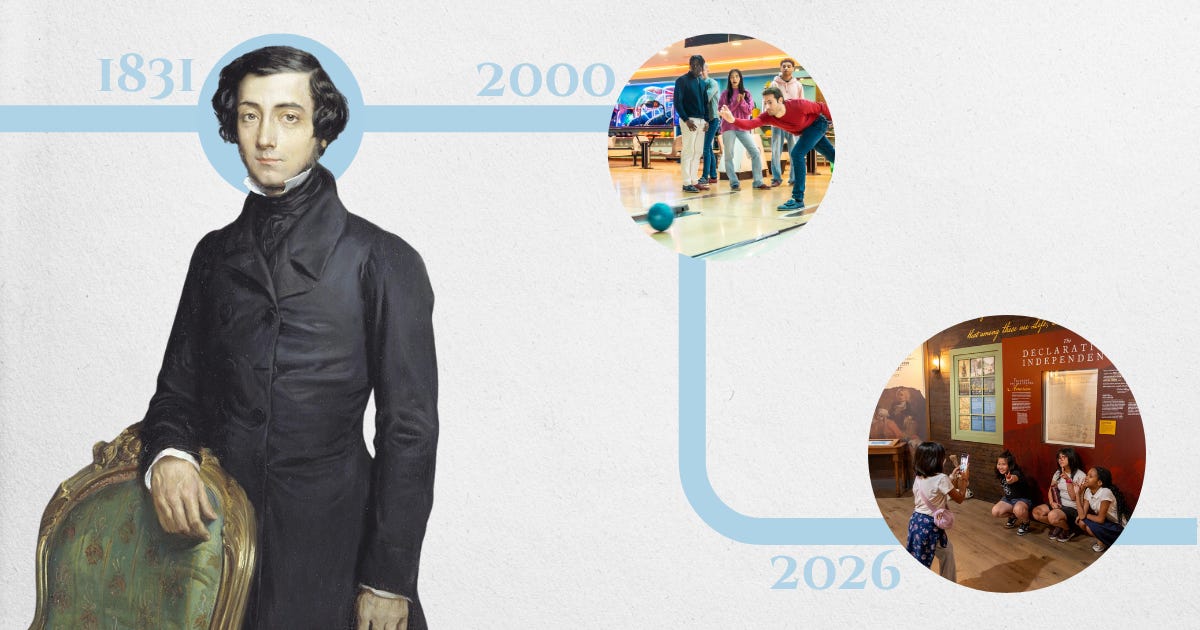
When Alexis de Tocqueville traveled through the United States in 1831 and 1832, he was fascinated by the American habit of forming associations. Americans organized themselves to establish schools, found hospitals, and build other institutions to serve their communities.
Tocqueville understood that a constitution could establish the framework for self-government, but it could not, on its own, cultivate the habits necessary to sustain it. Those habits had to be developed and practiced by the people themselves. Associations helped Americans learn how to organize, deliberate, compromise, lead, and take responsibility for shared concerns. They were both expressions of an active civil society and institutions through which Americans cultivated the habits of civic life.
Nearly two centuries later, political scientist Robert Putnam helped Americans understand what happens when those connections weaken. His landmark book Bowling Alone, published in 2000, documented declining participation in many forms of American civic life and popularized the concept of social capital: the relationships, networks, and norms of trust and reciprocity that help communities function.
The title captured the problem beautifully. Americans were still bowling. They were just increasingly doing so alone.
Twenty-six years later, we are still struggling to figure out how to bowl together again. Putnam’s diagnosis has been with us for more than a quarter century, yet we have not managed to reverse the weakening of the relationships and associations he documented. The pandemic accelerated our retreat from shared spaces and social routines, while digital life, polarization, and declining trust have placed additional strains on our connections to one another.
The 2023 documentary Join or Die, directed by Pete and Rebecca Davis, has introduced Putnam’s work to new audiences. Rather than offering another diagnosis of America’s civic challenges, the film shows people doing the work of rebuilding community and offers a wonderfully practical invitation: Join a club.
But that invitation reminds us of something essential: People need places to gather, organizations to join, and institutions that welcome them in. Sustaining those institutions is as important as encouraging Americans to participate in them.
Jonathan Haidt’s The Anxious Generation adds another dimension to this conversation. His work has focused public attention on the consequences of growing up in an increasingly phone-based world. But as families, schools, and policymakers consider healthier boundaries around technology, we should also ask what we are inviting children and teenagers to do when they put down their phones.
Where will they go? Whom will they meet? What opportunities will they have to develop friendships, discover shared interests, and become part of a community?
They need public parks, playgrounds, museums, libraries, recreation centers, and welcoming community organizations where they can discover that life beyond a screen is interesting and rewarding. Adults need those places, too. The young professional who moves to a new city, the parent looking for connection beyond work and family responsibilities, and the retiree seeking community and purpose all need opportunities to belong.
Amid so much of our lives moving online, people are increasingly seeking opportunities to connect face-to-face, discover shared interests, and enjoy one another’s company. Our civic institutions have an opportunity to meet that need. But we cannot simply ask Americans to become more connected. We have to make the alternatives to isolation available, accessible, and inviting.
Fortunately, much of the infrastructure we need already exists. Our museums, libraries, parks, houses of worship, community colleges, and local associations offer countless opportunities to gather around shared interests and purposes.
But the existence of civic infrastructure is not the same as its strength.
An institution can stand at the heart of a community without being central to the lives of the people who live there. A museum can house extraordinary collections and welcome fewer visitors. A library can offer programs that many of its neighbors never discover. A community organization can have a distinguished history while struggling to attract the next generation of participants.
If we want Americans to rediscover the benefits of association, we need to make better use of the institutions we already have. We need to help more people find their way through the doors, give them reasons to return, and create experiences through which shared interests become lasting relationships and opportunities to connect across differences.
But we also need to ensure those doors remain open.
The institutions that sustain civic life are more fragile than we often assume. Local museums, neighborhood associations, community centers, libraries, and other civic organizations face changing patterns of participation, rising costs, financial pressures, and the constant challenge of attracting new generations. History, longevity, and a valued place in a community are no guarantee of permanence.
That matters because civic infrastructure cannot be rebuilt once and then left to sustain itself. The places where people gather, learn, form relationships, and practice the habits of association require continual participation and investment. We cannot rebuild the habits Tocqueville admired if the institutions through which people practice them are weakening.
Sustaining them requires people who recognize their value and make them part of the ordinary rhythms of their lives: visiting, joining, volunteering, attending programs, bringing others with them, and building family and community traditions around these places. It also requires philanthropy that recognizes the importance of investing in institutions themselves, not simply funding new initiatives.
The reason everyone is talking about Tocqueville again is that we recognize what is at stake. But recognition is only the beginning. Together, Tocqueville and Putnam offer a roadmap for civic renewal, reminding us that the relationships that hold a society together do not sustain themselves, nor do the institutions through which those relationships grow. Both require our participation, our investment, and our care. We cannot hope to mend the fabric of American civic life without renewing the institutions that give it strength, shape, and the capacity to endure.