


There is an oversimplified story we often tell about the American founding that is both incomplete and, at this particular moment, deeply misleading. The Declaration of Independence is signed in 1776. A new nation is born. Liberty triumphs. The story ends.
History, of course, was far messier, and far more instructive.
The generation that declared independence quickly discovered that winning a revolution was not the same as sustaining a constitutional republic. The Articles of Confederation, remarkable for their moment, proved unequal to the demands of self-government. The promise of the Revolution required something more durable: stronger institutions, a constitutional framework capable of governing a free people, and a civic culture that could sustain both.
So the founding generation did something extraordinary: they began again. Eleven years after the Declaration, they gathered in Philadelphia to ask one of the most consequential questions in American history: What would it take not simply to win liberty, but to preserve it for ourselves and our posterity?
The Constitution was their answer.
And, yet, here too the story of our founding does not end.
The decades that followed were devoted to giving constitutional government a durable foundation. Americans established new national institutions, debated the meaning of federalism and individual rights, ratified the Bill of Rights, built courts and systems of public administration, expanded educational institutions, founded voluntary associations, and gradually developed the civic habits necessary to sustain self-government.
The founders understood something we too often forget. Constitutions create governments. People sustain them.
Nearly half a century later, Alexis de Tocqueville recognized what had made the American experiment so distinctive. He admired the Constitution, but he was equally struck by the habits, institutions, and associations that surrounded it. Americans formed associations for every conceivable purpose. They built schools, churches, newspapers, charitable organizations, town meetings, and civic societies. They solved problems together long before they expected government to solve them. These institutions taught cooperation, responsibility, compromise, and the everyday practices of citizenship.
Tocqueville understood that constitutional government depends on far more than constitutional design. In modern terms, he understood that it also depended upon what we call constitutional culture.
He warned that democracy could just as easily produce isolation as participation. Citizens might retreat into private life, becoming disconnected from one another and from the institutions that sustain freedom. A democracy could retain its constitutional forms while gradually losing the civic habits that gave those forms meaning.
His warning feels remarkably contemporary.
For much of our history, Americans have understandably celebrated the Declaration of Independence, the Constitution, and the Bill of Rights as extraordinary achievements. But those documents did not secure the American experiment on their own.
What secured it was generation after generation of Americans who accepted responsibility for strengthening the institutions, associations, and civic culture that allowed constitutional democracy to flourish.
That history has never felt more relevant than it does today.
America’s 250th anniversary invited us to remember the founding. I spent years working alongside remarkable colleagues across the country to ensure it became more than a birthday celebration. Through national coalitions, collaborative initiatives, and planning efforts, we sought to transform the anniversary into a once-in-a-generation opportunity for civic welcome, belonging, reflection, and renewal.
In many ways, we succeeded. Across the country, extraordinary educators, museums, libraries, veterans’ organizations, civic groups, historical societies, and community leaders created opportunities for Americans to learn, serve, celebrate, and reconnect. Millions participated. Countless acts of civic generosity unfolded in communities large and small.
Yet taken as a whole, the anniversary often felt fragmented rather than shared. Moments of invitation were real, but they were too often momentary and fleeting.
The more I’ve reflected on that experience, the more convinced I’ve become that we asked too much of collaboration and too little of institution-building. We relied on networks when we needed infrastructure. We coordinated when we should have been building enduring capacity. We celebrated thousands of remarkable local efforts without investing early enough in the shared institutions, philanthropic partnerships, and civic architecture that could have connected those efforts into something larger than the sum of their parts.
That realization has stayed with me because I have come to believe it points toward one of the founding’s most important lessons: great constitutional moments do not end with celebration. They begin with the work of building what comes next.
In that respect, I find an unexpected historical parallel.
The Articles of Confederation reflected a nation rich in ideals, talent, and local commitment, but one that lacked the institutional framework necessary for sustained collective action. The states were capable of remarkable things individually, yet too often struggled to act together as one nation.
America’s 250th revealed a different version of the same challenge. Across the country, extraordinary organizations accomplished extraordinary work. What we lacked was not creativity or commitment. We lacked sufficient shared infrastructure, sustained investment, and common purpose to transform thousands of individual efforts into a lasting movement for civic renewal.
That is not a criticism. It is a lesson. And it may be the most important lesson America’s 250th has to offer. The founders responded to fragmentation by building stronger institutions. We have the opportunity to do the same.
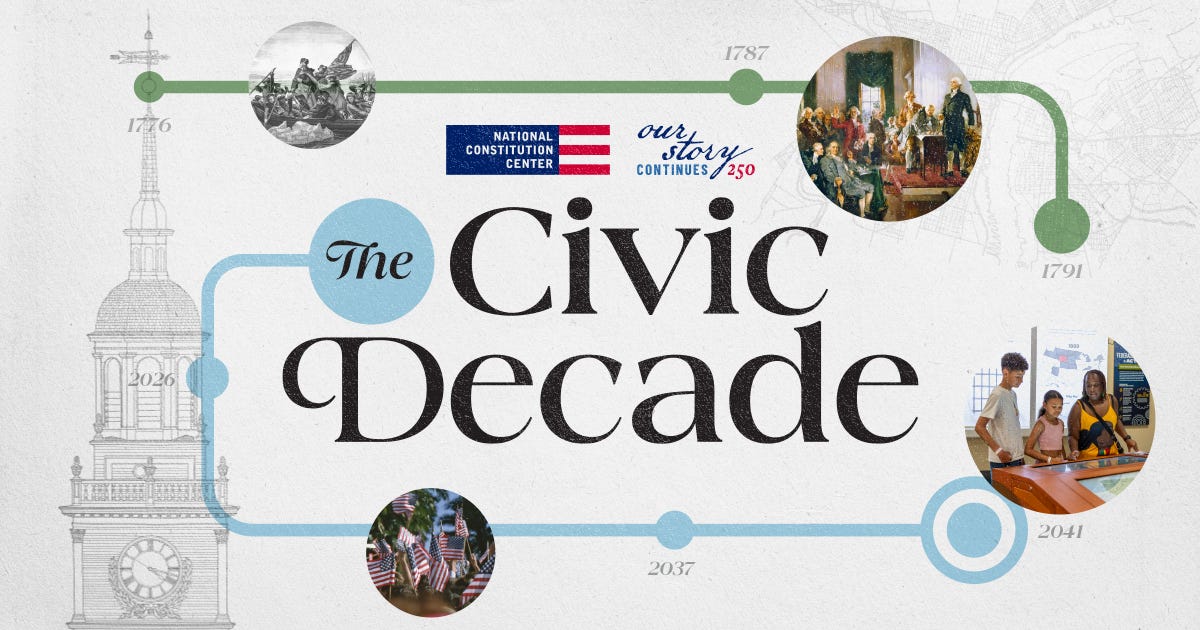
That is why I believe the decade and a half between the Declaration’s 250th anniversary this year, the Constitution’s 250th in 2037, and the Bill of Rights’ 250th in 2041 should be understood not simply as a sequence of commemorations, but as a national period of civic renewal.
At the National Constitution Center we call that project the Civic Decade.
Not because it is literally 10 years long—it isn’t (it’s actually 15 years long)—but because it represents a distinct era with a distinct purpose.
The Civic Decade is an invitation to treat this generation the way the founding generation treated theirs: as a moment not simply to celebrate our constitutional inheritance, but to strengthen the institutions, civic habits, and constitutional culture that will determine whether it flourishes for another 250 years.
Democracy has always been fragile. Self-government has always required work. Constitutions do not preserve themselves. Rights do not defend themselves. Institutions do not build and renew themselves. People do.
The question before us is not whether America will celebrate its founding. The question is whether we will use this remarkable sequence of anniversaries to leave behind a stronger constitutional democracy than the one we inherited.
That requires us to begin asking a different set of questions.
What would success actually look like?
For me, it would mean stronger civic institutions that more Americans visit, support, volunteer with, and trust. Museums, libraries, archives, schools, local governments, historical societies, civic organizations, courts, and places of constitutional memory should emerge from this period more vibrant than they entered it.
It would mean a national recommitment to civic learning—not only through major investments in K–12 education, but throughout American life. Civic learning should happen in classrooms, certainly, but also around dinner tables, in museums, libraries, faith communities, neighborhood organizations, and workplaces. We should recover the understanding that preparing children for citizenship is not solely the responsibility of schools. Families have always been our first civic institutions. Reviving a culture of civic parenting may prove one of the most important investments we can make.
It would mean rebuilding American civil society. More Americans participating in local organizations. More volunteering. More opportunities for neighbors to know one another. More places where disagreement is practiced with respect rather than contempt. At a time of growing loneliness, isolation, and polarization, rebuilding civic life is not only good for democracy. It is essential to human flourishing.
It would mean cultivating a richer constitutional culture defined not only by greater knowledge of our founding documents, but by deeper habits of curiosity, humility, civil dialogue, institutional trust, and shared responsibility.
And it would mean developing the courage to measure whether any of this is actually happening.
One of the projects I’m most excited to lead through my work at the National Constitution Center is helping define what success during the Civic Decade should look like. Not simply counting visitors, programs, or events, but asking more meaningful questions.
Are Americans more connected to civic institutions?
Are families talking more about citizenship?
Are young people receiving richer civic learning?
Are communities investing more deeply in the organizations that sustain democratic life?
Is civil society stronger than it was when this decade began?
This Substack is my attempt to think through those questions in public.
Together we’ll explore constitutional culture, civic learning, civic parenting, philanthropy, museums, civil society, institutional trust, civic infrastructure, the role of technology, and the ideas that might shape America’s next great chapter.
We’ll learn from historians, educators, constitutional scholars, technologists, philanthropists, institutional leaders, parents, and civic practitioners. We’ll celebrate promising experiments. We’ll acknowledge failures honestly. And we’ll ask, over and over again, what self-government requires of us now.
The founders did not leave us a finished form of government.
They left us the responsibility to keep building it.
The Civic Decade begins now.
I’m grateful you’re here.