


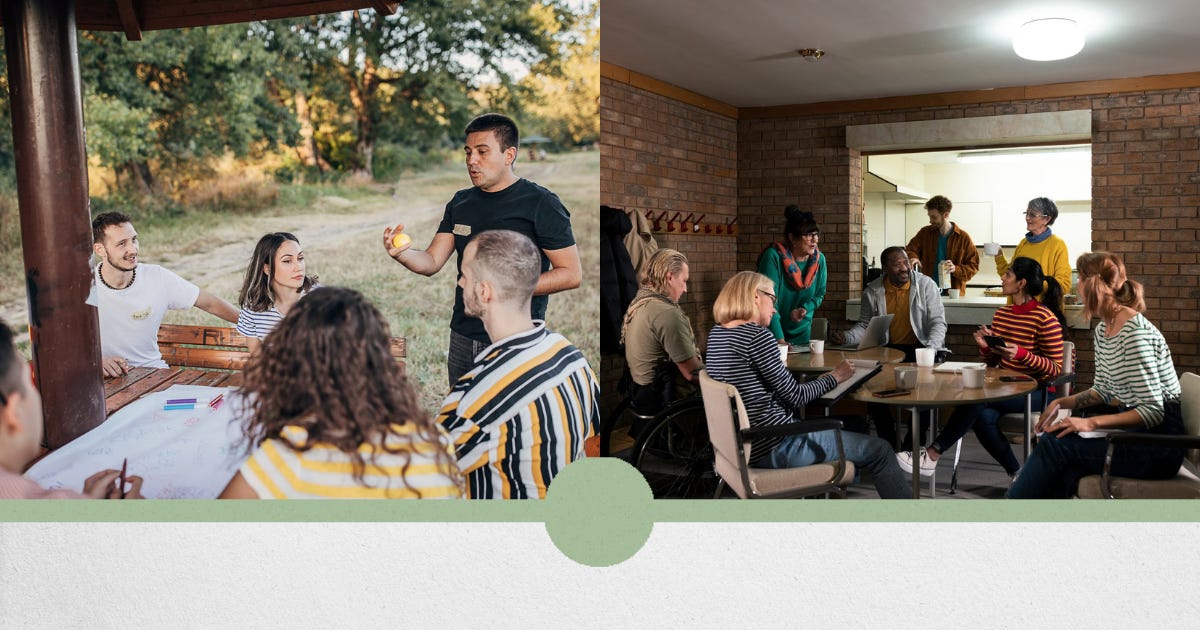
Civic infrastructure looks very different from one community to the next. Some places have a dense network of institutions that regularly invite people into civic life. In others, those opportunities are much thinner. Until recently, that landscape has been difficult to see, much less quantify.
I recently learned about a remarkable effort to do exactly that from my wonderful colleague Ashley Berner at Johns Hopkins. The Mapping the Modern Agora project at the SNF Agora Institute analyzes more than 1.7 million nonprofit organizations to identify where opportunities for participation exist. Its MapAgora Dashboard makes that research accessible at the community level and gives us a much clearer picture of civic infrastructure across the country.
This matters because many of our civic challenges are still analyzed from a national altitude, through broad measures of trust, polarization, isolation, civic knowledge, and participation. Those measures are important, but they cannot tell us what civic life looks like in a particular place.
Mapping the Modern Agora helps us get closer to the ground and see something national averages obscure: Communities differ significantly in the civic opportunities available to the people who live there. Some places have relatively deep civic infrastructure, with many organizations offering recurring ways to join, volunteer, gather, and participate. Others have thinner infrastructure, where those opportunities are fewer, less varied, or harder to find. At the furthest end of that continuum are what researchers have called “civic deserts,” places where opportunities for civic learning, connection, and participation are especially scarce. The distinction is not simply about the number of organizations in a community. It is about whether people have multiple, durable pathways into civic life.
Those differences should shape how we think about investment. A community with relatively deep civic infrastructure may benefit most from targeted support that helps strong institutions reach more people, connect with one another, or expand work that is already succeeding. A place with thinner infrastructure may need more sustained investment in local leadership, institutional capacity, and new pathways for participation. And in civic deserts, the challenge may be more foundational: building or strengthening the institutions, relationships, and opportunities that make participation possible in the first place. The depth, duration, and form of investment should reflect those differences, with particular attention to places where civic infrastructure is weakest.
This is the logic of a place-based strategy for civic renewal. In many communities, the most important investments will be grassroots ones: supporting local leaders, strengthening institutions that already have trust and reach, connecting organizations that are working in isolation, and helping promising local efforts grow. The work should begin with a clearer understanding of what a particular community has, what it needs, and what is most likely to endure.
Local civic infrastructure, however, does not have to be built from scratch or built alone. National institutions often have missions, programs, expertise, and incentives that bring them into communities across the country, while philanthropy often wants to support work that can scale. The opportunity is to align those national ambitions with local capacity-building.
Better data can help make that alignment more intentional. National organizations can bring tested programs, professional development, research, convening power, and broader networks in ways that respond to the local landscape. Just as important, they can design partnerships that leave local institutions better equipped to carry the work forward by training staff, developing local leaders, strengthening relationships among organizations, sharing tools and resources that can be adapted over time, and helping institutions build the systems and confidence to continue the work on their own.
Philanthropy can support both sides of that equation: direct investment in local capacity and the scaling of effective national work in ways that strengthen the places where it operates. Done well, national reach helps build stronger local institutions, and those stronger institutions make national impact more durable. The aim is not simply to deliver a successful program in more places. It is to expand impact in ways that leave behind greater civic capacity than existed before.
If this is the approach, then the geography of civic opportunity should inform the geography of civic investment. Mapping the Modern Agora can help us make more intentional choices about where existing capacity can be strengthened, where local efforts deserve deeper support, where partnerships with national organizations could accelerate or extend good work, and where genuinely new infrastructure may be needed.
We should be able to return to the dashboard year after year and see and measure the change: local civic infrastructure thickening, more communities developing durable opportunities for participation, and more places gaining the capacity to sustain civic life over time.
The opportunity now is to turn that insight into a strategy for renewal. Civic renewal will not happen everywhere in the same way, or at the same pace. But over the next 15 years, we can become far more intentional about where we invest, what we strengthen, and what we build. If we pair better data with local leadership, sustained investment, and national partnership, then the geography of civic opportunity in America can change. Community by community, we can thicken the civic infrastructure that gives people more ways to gather, contribute, participate, and practice self-government together.