


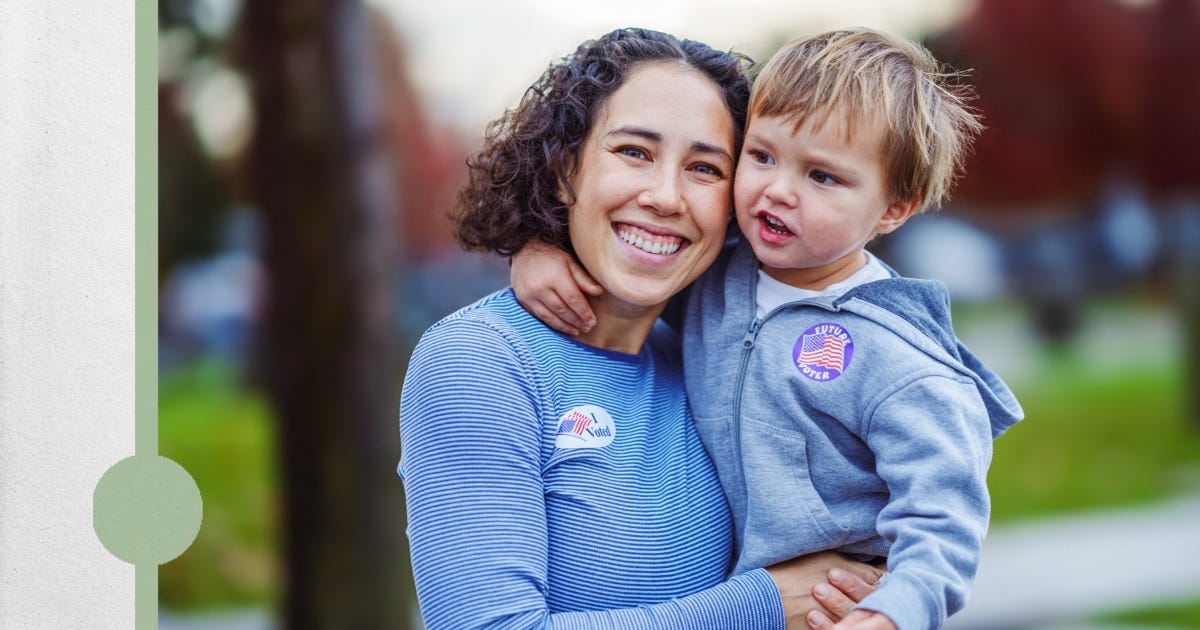
My kids will be late for daycare and school this morning, because they’re heading to the polls with me as we start our day.
Taking my two young daughters to vote with me is one of my favorite family traditions. At ages 3 and 5, they don’t yet understand much about elections or constitutional self-government. But they know that Election Day is special in our family. We go to the polls together, wait our turn, watch the voting process unfold, and, of course, collect our “I Voted” and “Future Voter” stickers. My goal is to introduce them through these shared experiences to the importance of civic participation, creating a foundation on which they can build a deeper understanding of the values and responsibilities of citizenship as they grow.
Voting is a civic ritual, and one of the most important we share as Americans. It is certainly not our only civic ritual, a subject I’ll explore more fully in another piece. Its importance lies in giving citizens a direct role in choosing those who govern them. Its distinctive advantage as a civic ritual is that it comes with a built-in invitation to participate. Elections return at regular intervals, at designated times and places, through familiar procedures. We show up, check in, receive a ballot, and make our choices. In doing so, we join millions of fellow Americans in exercising one of the fundamental responsibilities of self-government.
Civic rituals matter not simply because of what they commemorate or express, but because of what they teach and transmit. Repeated experiences can turn unfamiliar activities into familiar routines, routines into habits, and habits into enduring practices. When shared across generations, they also become a way of passing along values and expectations about our responsibilities to one another.
Children encounter those values not only through formal instruction, but by watching what the adults in their lives do, what we make time for, and what we return to year after year.
For young children, a trip to the polls offers a particularly vivid introduction to constitutional democracy. There are neighbors waiting in line, election workers helping voters, and ballots filled with names and questions.
And there is a lesson in the inconvenience, too. As I shared in a recent episode of Civic Parenting, “The Family Guide to Voting: Preparing Kids for the Midterms,” standing in line with two young children can be its own exercise in patience and perseverance. But by bringing them along, even when it complicates our morning routine, I’m communicating something that no lecture about civic responsibility could convey quite as effectively: Voting is worth the effort.
My guest, University of Virginia professor John Holbein, co-author of Making Young Voters, studies an important puzzle in American democracy: why so many young people who intend to vote ultimately don’t. His research suggests that the problem often isn’t indifference. Young people care about public issues, but the mechanics of voting can often feel unfamiliar or overwhelming. They may lack confidence, struggle with registration, or simply find it difficult to follow through. The challenge is translating civic intentions into civic action.
Our conversation explored how parents can help children develop the knowledge, confidence, and habits of participation at every stage of childhood.
For preschoolers and elementary school children, the emphasis is on familiarity and experience. Bring them to the polls. Show them what a ballot looks like. Explain what you’re doing in simple terms. Read books about elections and government. Give them opportunities to participate in age-appropriate family decisions, even something as ordinary as voting on a family activity or what you’re eating for dinner on a particular evening. These small experiences introduce children to the idea that their voices matter and that making decisions together sometimes means accepting outcomes different from what we personally prefer.
In middle school, begin introducing more complexity. Talk about issues affecting your community, explore why reasonable people can reach different conclusions, and invite children to ask questions and express their own views. Help them distinguish facts from opinions, consider different perspectives, and practice respectful disagreement. Keep bringing them to the polls, but deepen the conversation about what they’re observing. Discuss the different offices and issues on the ballot, why those decisions matter, and how elections connect to the institutions and communities that shape their daily lives.
By high school, the emphasis shifts toward independent judgment and practical preparation. Encourage teenagers to explore issues they care about, evaluate information from reliable sources, and develop political views of their own, including views that may differ from yours. Give them opportunities to discuss and defend their positions while remaining open to new evidence and perspectives. As they approach voting age, help them navigate the practical steps, from preregistration where available and voter registration to researching candidates, understanding ballot questions, and making a plan to cast their first vote.
And when they cast that first ballot, celebrate it! John and I talked about how important it is to make that experience memorable. We celebrate graduations, birthdays, and other milestones that mark our children’s growing independence. Why shouldn’t the first exercise of one of their most important rights be among them?
This brings me to what I find most compelling about voting as an intergenerational civic ritual: We can pass along the practice without prescribing the choice. Our children may ultimately arrive at political conclusions very different from our own. But through the experiences we share with them, we can communicate that participation matters, that independent judgment carries responsibility, and that our constitutional system depends on citizens who are willing to take part in it.
Over time, a childhood experience can become a personal commitment and an enduring civic practice. And eventually, that practice can become something we pass along to another generation.
John and I also discussed the importance of joy and celebration in sustaining civic engagement. Our elections are serious affairs, but seriousness need not exclude celebration. In a political culture so often dominated by anger and anxiety, we should make room for the pride, gratitude, and sense of connection that can accompany participation in self-government.
I want my daughters to grow up associating Election Day not simply with political contests, but with family, community, and the experience of participating in something larger than themselves. Maybe years from now, they’ll be the ones running a little late to school and work because they’re taking their own children to the polls.
And one final thought as we head into Election Day: The lessons we teach our children don’t end when we leave the polls. How we respond to the results is an important part of the example we set, too.
Our children notice how we celebrate victories, handle disappointments, and talk about people who voted differently than we did. We can model respect for the outcomes of free and fair elections while showing them that deeply held convictions need not come at the expense of kindness or curiosity. In our family, I try to focus conversations less on who we’re for or against and more on what we believe and why, while encouraging an understanding of why others might see things differently.
My daughters are growing up surrounded by friends and family who hold a wide range of political and ideological views, and I consider that an important part of their civic education. I want them to understand that we can profoundly disagree with someone and still love, respect, and value that person in our lives. After all, the same democracy that gives us the opportunity to make our voices heard also asks us to live alongside people whose voices and choices differ from our own. That’s a lesson I want my daughters to carry with them long after Election Day.
If you have children in your life, make voting a family tradition! And if you’re heading to the polls together today, share a photo of you and your kids proudly sporting your “I Voted” and “Future Voter” stickers and tag #CivicDecade or share it in the comments below. I’d love to see how families across the country are celebrating this important civic ritual and passing it along to the next generation!
Great post, Julie. Jane Eisner wrote a great book years ago called Take Back the Vote that urges honoring the first time a young person votes like a a big birthday or coming of age party in many traditions or getting that drivers license. Maybe NCC could take that on and make it a big deal.
Taking a 3 and a 5 year old to the polls and coming home with 'Future Voter' stickers is my favorite kind of civics lesson. Letting them see the inconvenience is smart too, since waiting in line with neighbors is what they'll remember years from now.