


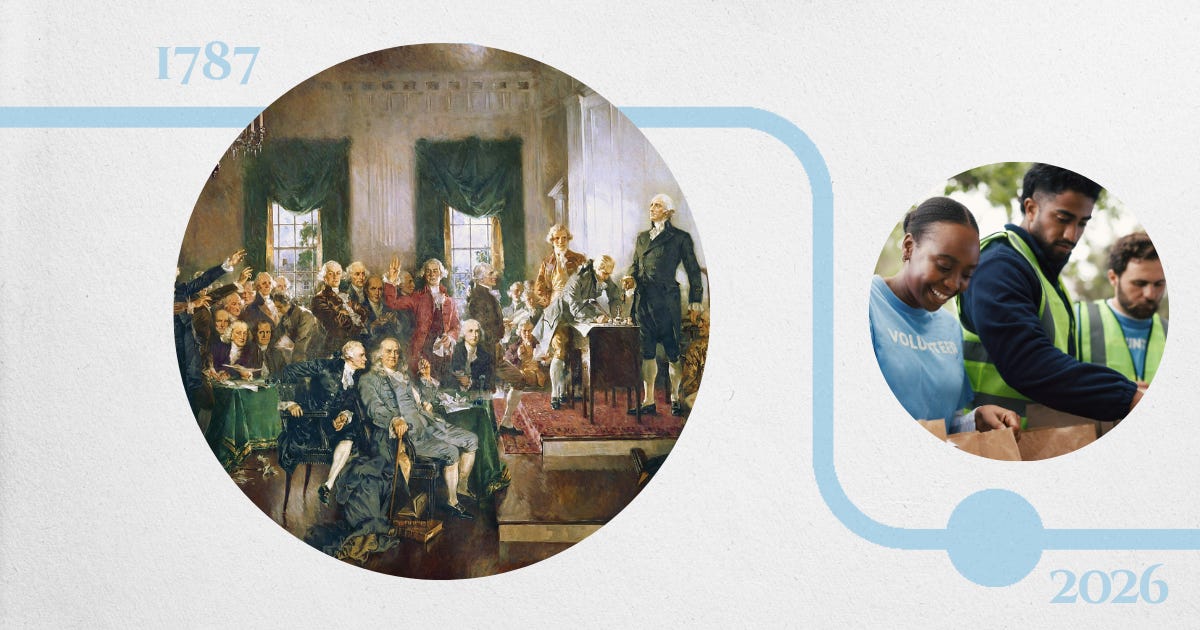
Constitutions create governments. People sustain them.
That simple distinction may be one of the defining lessons of the Civic Decade.
A constitution establishes the framework of self-government. It distributes power, protects rights, creates institutions, and provides peaceful means for resolving disagreement. But constitutions alone cannot create the civic habits, institutions, or culture that allow constitutional democracy to endure. Those must be built, practiced, and renewed by each generation.
Judge Learned Hand captured this truth when he warned that we often “rest our hopes too much upon constitutions, upon laws and upon courts.” Liberty, he reminded us, “lies in the hearts of men and women; when it dies there, no constitution, no law, no court. . . can save it.”
Hand was not dismissing the Constitution. As one of America’s most respected judges at the time, he understood the indispensable role of constitutions, laws, and courts. His point was more demanding: governing institutions cannot preserve liberty if the people themselves cease to value it.
As we enter the Civic Decade, we have a once-in-a-generation opportunity to strengthen the constitutional culture that allows constitutional democracy to endure and flourish.
Constitutional culture is the civic life that surrounds, supports, and gives meaning to our constitutional system. It is the body of knowledge, habits, relationships, institutions, expectations, and moral commitments through which a society learns to live under a constitution.
It includes an understanding of constitutional principles and history. But knowledge alone is not enough.
Constitutional culture also includes habits of restraint: the willingness to exercise less power than one might possess, to respect legitimate opposition, to accept lawful outcomes, and to preserve rules that may one day protect one’s adversaries as well as oneself.
It includes habits of participation: voting, serving, organizing, deliberating, volunteering, petitioning, persuading, and taking responsibility for the life of one’s community.
It includes habits of relationship: learning to work with people whose experiences and convictions differ from our own, building trust through common effort, and recognizing that citizenship creates obligations among strangers.
And it includes a shared conviction that constitutional democracy is not someone else’s responsibility. It is a common inheritance entrusted to each of us.
The idea is far older than the United States Constitution.
Ancient thinkers understood political life not simply as a contest for power, but as a formative activity. Aristotle argued that political communities shape the character of their citizens. Although his conception of citizenship reflected the exclusions of the ancient world, he offered an enduring insight: political institutions do more than govern people. They help form them.
Centuries later, Montesquieu carefully examined constitutional design. He insisted that institutions alone could not sustain a republic. Every republic, he argued, depends upon political virtue. By this he meant not private perfection, but a love of the republic and its laws and a willingness to place the public good above private interest.
The American Founders inherited both traditions.
They did not believe that human beings could be trusted with unchecked power. That is why they created separated institutions, check and balances, federalism, representation, and regular elections.
But neither did they believe that constitutional machinery could compensate for every human failing.
In Federalist No. 55, James Madison acknowledged the darker elements of human nature that make safeguards necessary. But he also insisted that republican government presupposes enough esteem, confidence, and virtue among the people to make self-government possible. A political system built entirely on distrust could not remain republican at all.
John Adams put the matter even more directly: “Public Virtue cannot exist in a Nation without private Virtue, and public Virtue is the only Foundation of Republics.”
Constitutional design could restrain power. Civic life would have to cultivate a people capable of exercising it wisely.
Few thinkers understood the relationship between constitutional design and civic life more clearly than Alexis de Tocqueville. He came to America searching for the deeper sources of democratic self-government. He studied constitutions and laws, but he looked beyond them. He paid attention to townships, churches, newspapers, voluntary associations, juries, families, and the countless settings in which Americans learned to act together.
These institutions mattered because they taught the practice of freedom. In associations, individuals discovered that problems they could not solve alone might be addressed through common effort. They learned to organize, deliberate, compromise, persuade, lead, follow, and trust. Tocqueville believed that associations were especially necessary in democratic societies because they allowed ordinary people to combine their energies and resist both isolation and excessive dependence on centralized power.
This is what we mean by civic life. It is where constitutional culture takes root.
It is not simply politics. In fact, much of it takes place far from electoral campaigns and government institutions. It unfolds wherever people assume responsibility for something they share.
It is the parent who brings children to a library and introduces them to stories larger than their own.
It is the teacher who creates a classroom in which students learn to disagree without withdrawing from one another.
It is the neighbor who organizes a food drive, the volunteer who serves on a local board, the journalist who reports carefully, the congregation that cares for its community, and the museum that helps visitors encounter the beauty and complexity of the American story.
It is the debate society, the youth sports league, the historical association, the community foundation, the local newspaper, the book club, the service organization, and the town meeting.
These institutions do more than meet immediate needs. At their best, they form citizens.
Modern scholars have given new language to some of what Tocqueville observed. Robert Putnam called it social capital: the networks, relationships, and habits of trust that allow people to cooperate. His work warned that as participation in civic and community life declines, societies lose more than clubs and meetings. They lose the connective tissue that enables people to solve common problems and sustain a shared civic life.
Constitutional culture requires social trust, but it is more than social cohesion. A society may be tightly connected and still be unjust. People can possess strong bonds within their own communities while remaining suspicious of everyone outside them. Civic life can reinforce exclusion as easily as belonging.
A healthy constitutional culture therefore requires more than connection. It asks us to build relationships across lines of difference and to bind our civic life to constitutional principles: liberty, equality, human dignity, the rule of law, and freedom of conscience, to name a few.
It requires both conviction and humility. Both majority rule and minority rights. Both attachment to community and respect for the individual conscience.
Learned Hand offered perhaps the clearest description of the civic disposition constitutional democracy requires. The spirit of liberty, he said, is “not too sure that it is right.” It seeks to understand the minds of others and remembers that even the least powerful person deserves to be heard.
Hand was describing the discipline of democratic life. The humility to recognize that no individual or faction possesses the whole truth. The courage to defend the freedom of those whose views we reject. The generosity to weigh another person’s interests alongside our own. The restraint to refuse every power that law or circumstance might place within our reach. And the faith that our fellow citizens remain capable of reason, persuasion, growth, and common purpose.
None of these qualities can be manufactured by constitutional text alone. But neither do they arise spontaneously. They must be taught. Practiced. Modeled. Rewarded. Renewed. They must be cultivated in the institutions of civic life, long before they are tested in moments of constitutional tension or crisis.
That is why constitutional culture cannot be treated as a soft concern at the margins of public life. It is not ornamental to constitutional democracy. It is part of its essential infrastructure.
Schools can teach constitutional principles. Constitutional culture determines whether we practice them.
Courts can defend the freedom of speech. Constitutional culture determines whether we use that freedom to seek truth or merely to wound.
Elections can transfer political power. Constitutional culture determines whether winners exercise that power with restraint and losers remain committed to the system.
The Constitution can preserve space for disagreement. Constitutional culture determines whether we approach those disagreements with mutual respect and a shared commitment to self-government.
This does not mean that constitutional design is unimportant, or that civic virtue should be invoked to excuse institutional failure. Unjust laws must be changed. Broken institutions must be repaired. Constitutional rights must be enforced.
Institutions shape behavior, distribute opportunity, and influence the kind of civic culture that develops around them. And throughout American history, citizens denied full membership in the constitutional community have drawn upon the nation’s own principles to demand that its institutions become more just.
The relationship runs in both directions. Institutions can encourage trust or corrode it. They can reward cooperation or deepen division. They can widen participation or close it off.
But even the best institutions depend on people willing to use them for constitutional ends. Reforming the machinery of democracy will never eliminate the need to form democratic citizens.
This is the opportunity of the Civic Decade.
The anniversaries of the Declaration of Independence, the Constitution, and the Bill of Rights invite us to do more than celebrate remarkable documents. They invite us to strengthen the constitutional culture that allows those documents to endure.
Will the next generation inherit strong institutions of civic learning and belonging?
Will they have places where they can encounter people unlike themselves, practice civil disagreement, and discover their capacity to contribute?
These questions cannot be answered in Washington alone. They belong to families and schools, museums and libraries, community organizations and houses of worship, philanthropists and universities, local leaders and ordinary citizens.
They belong wherever constitutional culture is being formed, which is to say, everywhere.
Constitutions create governments. People sustain them.
The future of constitutional democracy depends upon the civic life we choose to build together.
Very well said! And thinking especially of associations in which young people might develop constitutional culture, I'm interested in thoughts about this problem: the great majority of institutions that control the time of young people, starting with school, are essentially anti-democratic. They are told to ready themselves for the essentially anti-democratic workplace. What does democracy enacting education look like? Not 'free ' schools, but constitutional schools?
💯 Excellent!