


In 2013, Mississippi ranked 49th in the nation in fourth-grade reading. By 2024, it ranked ninth. Over those 11 years, the percentage of Mississippi fourth graders reading at or above the proficient level rose from 21% to 32%, even as proficiency rates declined nationally. A state once near the bottom of the rankings had become a national leader in reading achievement.
Mississippi’s progress followed sustained investments in research-informed reading instruction, teacher preparation, coaching, assessment, and implementation. Although researchers continue to examine the contributions of individual reforms, the larger lesson is compelling: educational improvement requires understanding how people learn, measuring results, and building the capacity to put evidence into practice.
The Science of Reading has helped establish a more rigorous foundation for literacy instruction. Now, researchers are calling for similar attention to mathematics. In a recent conversation with Rick Hess, cognitive scientist Daniel Ansari argued for stronger connections between research on how children develop mathematical understanding and the preparation and practices of teachers.
We need to bring that same ambition to civics.
Across the country, educators and civic organizations have developed outstanding resources to help Americans understand our constitutional system and prepare for the responsibilities of citizenship. Schools teach American history and government. Museums, libraries, and civic institutions create opportunities for learning, dialogue, and participation. Families introduce children to questions of fairness, rights, and responsibility long before formal instruction begins.
We also have important research on which to build. Yet the evidence about the state of civic learning should sharpen our sense of urgency.
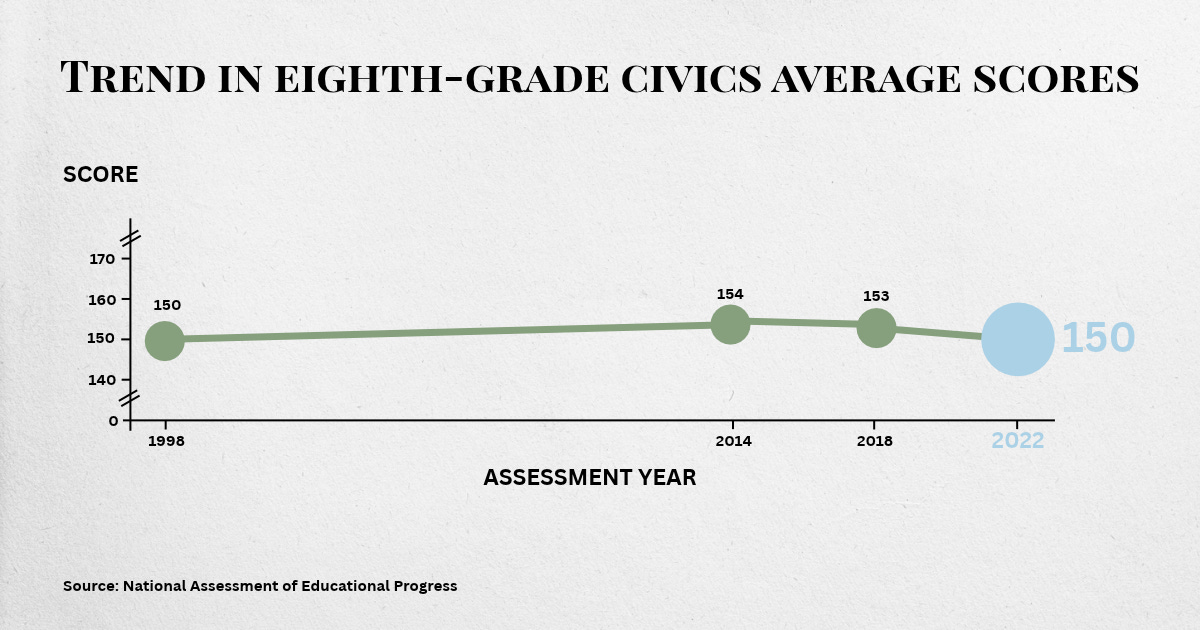
The National Assessment of Educational Progress provides decades of data on students’ civic knowledge. Its most recent civics assessment, in 2022, found that just 22% of eighth graders performed at or above the proficient level, statistically unchanged from 1998. Average scores were also no better than they had been nearly a quarter century earlier. Despite decades of effort, we have not achieved sustained national improvement on this important measure.
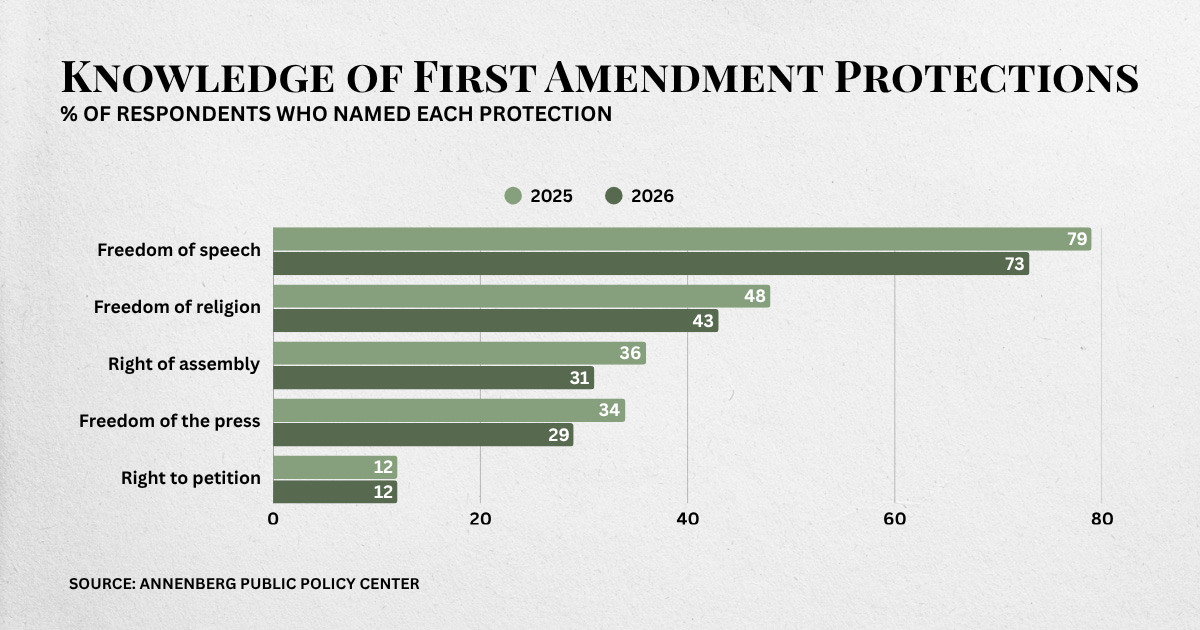
Adult civic knowledge reveals similarly persistent gaps. The University of Pennsylvania’s Annenberg Constitution Day Civics Survey has documented periods of improvement and decline, with little sustained progress in recent years. Between 2023 and 2026, the proportion of adults able to name all three branches of government fluctuated between 65% and 70%. In 2026, just 9% could name all five First Amendment rights.
These findings are troubling, but they illuminate only one dimension of a much larger challenge. Knowing how government is structured does not tell us whether Americans can apply constitutional principles, evaluate competing arguments, engage constructively across differences, or exercise meaningful influence in their communities. Nor does it reveal whether they possess the confidence, motivation, and habits necessary for sustained participation in civic life.
We need rigorous research and meaningful measures of each dimension of civic formation: knowledge, skills, dispositions, habits, values, and efficacy. Just as importantly, we need to understand how these capacities interact, reinforce one another, and develop across a lifetime. Does greater constitutional knowledge strengthen civic efficacy? Do experiences of meaningful participation motivate deeper learning? How do civic habits and dispositions influence whether people use the knowledge and skills they acquire? Understanding these relationships is essential to designing experiences that contribute to lasting civic development.
There are important foundations for this work. Researchers at CIRCLE have advanced our understanding of youth civic learning, participation, and barriers to engagement. Evaluations by civic education providers offer evidence about individual interventions. Drawing on an extensive body of empirical research, the 2011 Guardian of Democracy report identified six evidence-based practices for effective civic learning, including classroom instruction, discussion of current events, service learning, and opportunities for students to participate in school and community life.
In a 2019 review of the research, Notre Dame political scientist David Campbell identified growing evidence that well-designed civic education can have meaningful, lasting effects on young people’s civic engagement. He examined the contributions of classroom instruction, extracurricular activities, service learning, and school culture, finding that effective civic education can be especially valuable for young people who have fewer civic resources and opportunities at home or in their communities. Campbell also warned that the available data remained limited and randomized studies were rare. He called for a large-scale, interdisciplinary research effort using multiple methods to develop a stronger understanding of what works.
These contributions provide an important foundation, but the evidence remains fragmented. National assessments reveal trends, studies of participation identify influences on engagement, and program evaluations illuminate individual interventions. What we lack is a coordinated body of rigorous comparative and longitudinal research that can tell us which approaches work best, whether their effects endure, and how different dimensions of civic formation develop together through successive learning experiences.
The next generation of civic learning should be guided not only by our convictions about what matters, but by rigorous evidence about what actually works. The goal is not a single curriculum or a standardized measure of citizenship, but a stronger foundation for designing and improving civic learning across different settings and stages of life.
An important distinction is between what an educational experience accomplishes in the moment and what learners carry forward. A program may demonstrate immediate gains in knowledge, skills, or efficacy, but how much of that progress do participants retain over time? Which approaches are most effective for different learners and settings?
Answering these questions requires interdisciplinary research drawing on cognitive science, developmental psychology, and comparative and longitudinal studies. It also requires looking beyond individual experiences to understand how civic formation unfolds across a lifetime. A classroom lesson, museum visit, family conversation, and community program may each contribute to civic development, yet we rarely examine how these experiences reinforce one another or create pathways to progressively deeper learning and participation.
Understanding how civic learning develops also requires us to examine whom our institutions are reaching. Many organizations excel at serving high-achieving students, highly educated adults, engaged families, and people already interested in history or government. Deepening their knowledge matters. Yet a national strategy for civic renewal cannot depend primarily on those already inclined to participate.
Making excellent programs available does not guarantee that less-engaged audiences will seek them out. We need to understand what sparks curiosity, lowers barriers, and creates meaningful invitations into civic life. Research should help us design more accessible entry points, understand what sustains participation, and expand opportunities in communities where civic infrastructure is scarce.
This work also demands institutional humility.
Educational organizations develop programs through expertise, experience, and conviction. We invest in them and take understandable pride in their accomplishments. Yet what happens when the evidence reveals that a program is not achieving its intended impact? Participants may enjoy an educational experience but retain little of what they learn. A program may increase factual knowledge without strengthening the capacity to apply it. An initiative designed to reach new audiences may primarily attract those already engaged.
Such findings should prompt improvement, not defensiveness. A serious commitment to evidence requires the willingness to challenge our assumptions, reconsider our methods, and redesign programs when results fall short of our ambitions.
Institutional humility must also be matched by the resources to act. Evaluation may reveal the need to redesign curricula, strengthen educator preparation, change delivery methods, or redirect resources toward more effective approaches. That requires time, expertise, and sustained investment.
This is a responsibility that civic institutions cannot shoulder alone. Major philanthropy must partner with researchers and civic organizations to support not only rigorous research and evaluation, but also the experimentation, redesign, and implementation necessary to translate evidence into better practice. Larger, better-resourced civic organizations have a particular responsibility to undertake this work on behalf of the field. They are better positioned to test new approaches and assume institutional risks that smaller organizations, operating with more limited resources and capacity, cannot reasonably be expected to take.
Equally important is a commitment to sharing what works and what does not. Making these findings available will help organizations of every size build on successful approaches, avoid repeating unsuccessful ones, and make better-informed decisions about their programs. The goal is a shared body of evidence that strengthens civic learning across the field.
If we believe that civic learning is essential to sustaining constitutional self-government, we should be equally committed to making it more effective. A Science of Civics offers an opportunity to move from conviction to evidence, from isolated successes to shared knowledge, and from measuring our efforts to demonstrating their lasting impact.
*With thanks to my friend and colleague Victoria Hughes, the National Constitution Center is beginning to convene a Science of Civics Working Group to help advance this effort. We plan to draw on expertise across research, education, civic institutions, and philanthropy.
Wonderful and timely piece, Julie. We’ve been pushing for much better ways to measure progress than 8th grade NAEP, by which time many students haven’t even had a decent American government, history or civics course. Grateful to see the old Guardians of Democracy report we worked on with NCoC, and love drawing out examples at the state level that are outperforming other states and what we can learn from that. We did this on the dropout work over 20 years with good results. Thanks for the great post!