


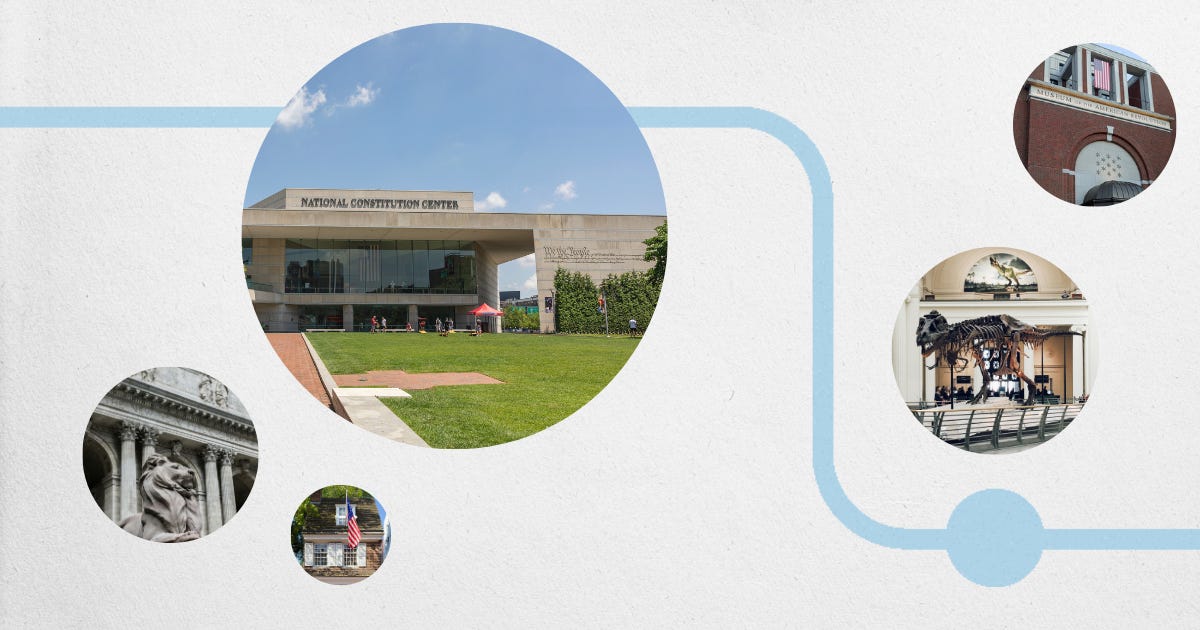
America’s civic institutions are all around us.
They are the museums that preserve our history and inspire our curiosity. The libraries where neighbors gather to learn and exchange ideas. The historic sites and national parks that connect us to the people and places that shaped our nation. The bookstores that bring authors and ideas into communities. The historical societies, archives, universities, community organizations, and cultural institutions that help us better understand our shared past and imagine our shared future.
We visit these places every day. We bring our children to them. We volunteer at them. We attend lectures, exhibitions, performances, and community conversations within their walls.
Yet we rarely think about them collectively.
Together, they form America’s shared civic infrastructure: a remarkable national network of trusted institutions that preserves our history, strengthens our communities, and creates lifelong opportunities to explore the Constitution, our civic traditions, and the responsibilities of self-government.
America already possesses one of the world’s greatest civic resources. The challenge is not building it. The challenge is recognizing its value, strengthening it, connecting it, and inviting more people to experience it.
The scale is extraordinary.
The Institute of Museum and Library Services has estimated that more than 35,000 museums operate across the United States, a broad universe that includes history and art museums, science centers, children’s museums, historic organizations, botanical gardens, zoos, aquariums, and more. A more recent national census identified more than 21,000 history organizations alone, many of them small organizations deeply rooted in their communities. And more than 120,000 libraries of all kinds serve communities across the country, including more than 17,000 public library locations.
Our civic infrastructure extends far beyond them. More than 100,000 properties are listed on the National Register of Historic Places, encompassing roughly 2 million historic resources. The National Park Service stewards 433 sites, while states collectively care for nearly 10,000 state park units. National Heritage Areas, presidential libraries, universities, archives, independent bookstores, cultural institutions, and community organizations extend this network even further.
The result is an extraordinary civic architecture spread across the country: places in communities large and small where Americans can encounter history, ideas, culture, and one another. These are the places where civic life happens.
Every day, families discover history together. Children encounter our nation’s founding documents for the first time. Visitors wrestle with difficult chapters of our past. Neighbors gather for conversations about their communities. Scholars bring new perspectives to enduring constitutional questions. Millions of Americans experience moments of curiosity, discovery, reflection, and connection that deepen their understanding of our country.
These experiences matter because civic learning is not confined to a single stage of life. It unfolds over a lifetime. A visit to a museum sparks a question. A conversation at a library deepens understanding. A book discovered at a neighborhood bookstore opens a new perspective. A walk through a historic site makes the past feel tangible. A public program brings people together around an idea. Each experience builds on the last, helping people develop the knowledge, judgment, and civic habits that sustain constitutional democracy.
Our civic institutions make those lifelong learning journeys possible. Yet despite their importance, we too often treat them as optional amenities rather than essential civic infrastructure.
Many operate with limited staff and resources. A small historical society may have deep knowledge of its community but little capacity to develop new educational programs. An independent bookstore may have the space and trusted relationships to convene an important civic conversation but lack the resources to identify speakers or build a program around it. A local museum may want to reach teachers and families but have limited capacity to develop curriculum or train staff.
The Civic Decade offers an opportunity to change that.
Larger civic institutions, universities, national organizations, and philanthropy can look beyond the boundaries of their own programs and ask how their resources can strengthen this broader civic infrastructure. Major museums can share programming and professional development with smaller institutions. They can connect scholars with libraries, bookstores, and historical societies. National organizations can make high-quality educational resources available to local partners. Funders can invest not only in individual programs, but in the relationships and shared capacity that allow institutions to learn from one another.
The goal is not to make these institutions the same or impose national programming from above. It is to help them do more of what they already do best: understand their communities, build trusted relationships, and create experiences that bring people together. Our civic infrastructure becomes stronger when knowledge, resources, and expertise are shared.
For those of us who lead, work in, fund, or partner with civic institutions, the charge is to strengthen this shared infrastructure and expand what it can offer.
But the future of these institutions does not rest on civic leaders alone. All of us have a role to play, and it begins with something wonderfully simple: Visit. And then return.
Walk through the doors of your local museum. Attend a program at your public library. Browse an independent bookstore. Explore a nearby historic site. Spend a day in a national or state park. Join a community conversation. Become a member. Bring a friend. Bring your children. Then come back for the next exhibition, conversation, book, or discovery.
Civic learning unfolds over a lifetime, and these institutions give us places to keep learning. The more often we enter them, participate in their programs, support their work, and make them part of our family and community lives, the richer our own civic lives become and the stronger these institutions become in return.
That is the opportunity of the Civic Decade: not to invent a new civic architecture, but to recognize the extraordinary one already all around us and invest in it from both directions. Institutions with greater capacity can help strengthen it. Individuals can experience, participate in, and support it.
If we do both, the legacy of these anniversary years will not simply be the celebrations we held. It will be a stronger civic infrastructure, more deeply woven into American life, for the generations that follow.
Find Civic Institutions Near You
Want to explore the civic institutions in your own community or where you’re traveling? The American Alliance of Museums offers a Find a Museum directory to help you discover museums across the country. You can also use the libraries.org directory to find public, academic, school, and other libraries near you.
This is brilliant—and I couldn’t agree more! Thank you for this clear and compelling message, Julie. The toolkit we made with Made By Us can help advance this cause :) https://historymadebyus.org/youth250/toolkit