


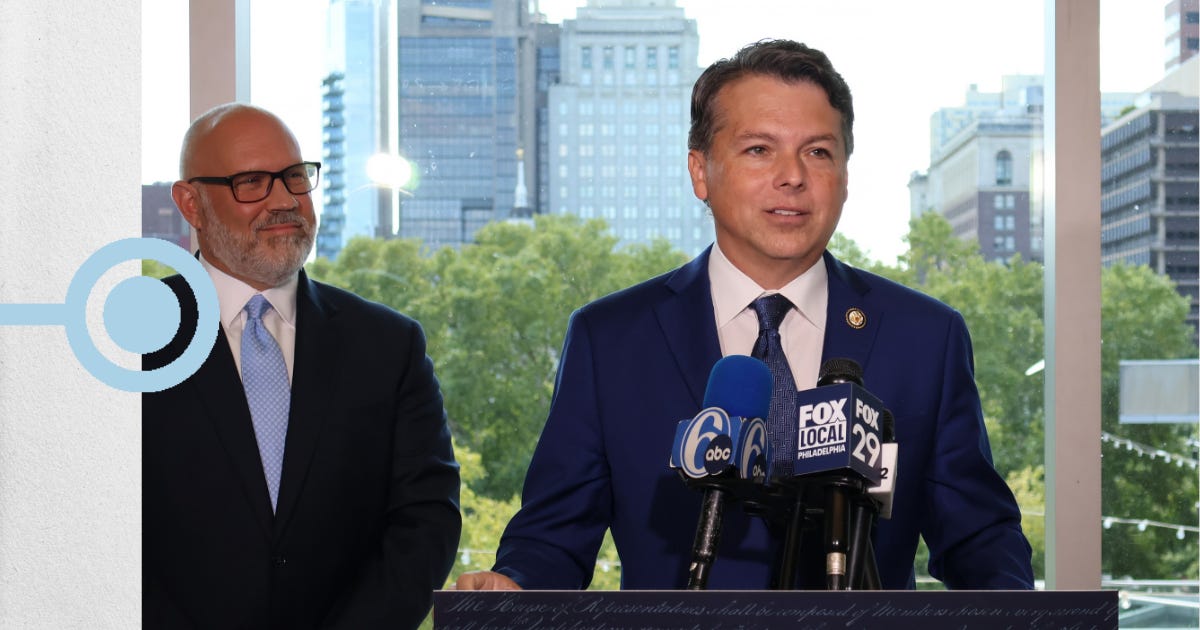
Last week, Congressman Brendan Boyle came to the National Constitution Center to announce plans for federal legislation establishing a national commission to begin preparing for the 250th anniversary of the Constitution in 2037. You can read more about the announcement here.
As Center interim President and CEO Vince Stango shared during the announcement, we have an opportunity to “sustain the partnerships, infrastructure, and spirit of coming together that [America’s 250th] anniversary has inspired, and to continue deepening investments in the civic, educational, and cultural institutions that connect Americans to our constitutional story.”
The experience of America’s 250th helps explain why beginning this work now matters, and why we should approach what comes next with even greater ambition.
Congress established the U.S. Semiquincentennial Commission in July 2016, almost exactly a decade before July 4, 2026. But creating the federal commission was only the beginning. The broader national infrastructure took years to develop. It would not be until the end of 2024 that Semiquincentennial planning entities were in place across all 50 states, five territories, and the District of Columbia.
America’s 250th has generated extraordinary civic activity across the country. State commissions have built networks and partnerships. Cities and towns have organized around their own histories. Museums, libraries, schools, universities, historical and cultural organizations, philanthropies, businesses, civic institutions, and government agencies have found new reasons and new ways to work together.
That capacity is one of the great successes of this anniversary.
But if we are serious about learning from America’s 250th, we should also be candid about its limitations. The national celebration often felt fragmented. Some of that reflects a healthy diversity of histories, institutions, and approaches. A country this large should not commemorate its past through one centrally directed story or program. But fragmentation has also had consequences. Local, state, and national efforts developed on different timelines and with uneven levels of coordination. Much of the infrastructure required for a truly national commemoration came together relatively late. And, perhaps most importantly, we never established a sufficiently coherent set of civic goals beyond commemorating the milestone itself.
There has been no shortage of excellent programming, ambitious partnerships, or institutions doing meaningful work. What has been harder is connecting those efforts to a shared understanding of what we wanted to be different in American civic life because we marked the 250th anniversary of our founding.
Individual organizations have pursued important goals for civic knowledge, participation, institutional strength, and civic formation. But as a nation and as a field, we did not establish a sufficiently clear set of shared outcomes, or agree on how we would measure progress toward them, early enough to organize the full power of this moment.
That is a lesson worth carrying forward: An anniversary date, however powerful, is not itself a strategy. And an extraordinary collection of commemorative activities is not the same thing as a coordinated effort to leave American civic life stronger than we found it.
The years ahead give us the chance to do more. But first, we have to resist the instinct to wind down what we have spent so long building.
The civic capacity created for 2026 should not have a 2026 expiration date. Where state commissions have built meaningful relationships, expertise, and networks, we should work to keep them intact. Their mandates can evolve. Their programs should change. But the capacity to act together should endure.
The same is true of the partnerships among state and local governments, museums and libraries, schools and universities, historical and cultural institutions, philanthropy, business, and civic organizations. Those relationships took years to build. To allow them to dissipate now would be to surrender one of the most valuable legacies of America’s 250th just as it becomes most useful.
At the national level, Congressman Boyle’s proposal for a new bipartisan commission offers an opportunity to establish coordinating capacity early, while those networks are active and the experience of 2026 is still fresh.
This work does not need to wait for a new federal commission, however. These conversations are already happening at the state, local, and organizational levels, and I find that tremendously encouraging.
Across civic education, history, culture, philanthropy, higher education, business, government, and other sectors, leaders are already looking beyond 2026. Some are focused on the Constitution’s 250th in 2037. Others are looking through to the Bill of Rights’ 250th in 2041. They may use different language and frameworks, but many are looking toward the same horizon and asking versions of the same question: What can we build together over these years that would leave our institutions stronger, our communities more connected, and future generations better prepared for the responsibilities of self-government?
Now we need to make sure those conversations bear fruit.
The next decade should not be organized primarily around another countdown to another anniversary. It should be organized around what we intend to accomplish by the time we reach it.
That requires a clearer set of goals for civic knowledge, participation, and trust; a shared commitment to strengthening the institutions that sustain civic life; and a more expansive understanding of civic formation that encompasses learners of all ages, from early childhood through adulthood and across generations. It also requires us to hold ourselves accountable for progress. What do we want to be measurably different by 2037 and 2041, and what are we prepared to do together to make it happen?
We should establish better ways to understand the health of civic life over time, including an annual civic barometer that allows us to see where progress is being made and where challenges remain. We should become more rigorous about measuring the impact of civic programs and interventions, not simply their reach. We should connect researchers and practitioners to build a stronger science of civics and a better understanding of what works, for whom, and under what conditions. And we should strengthen the institutions capable of supporting civic learning and engagement across generations, long after the anniversaries themselves have passed.
The National Constitution Center is uniquely positioned to help lead this next chapter, and our own history helps explain why. The Center was born of the Constitution’s bicentennial, when Congress recognized that the anniversary should leave behind more than a national celebration. Through the Constitution Heritage Act of 1988, Congress established a private, nonprofit museum with a national mandate for nonpartisan constitutional education. We are ourselves an enduring legacy of an earlier constitutional milestone, entrusted with carrying its educational purpose forward. As America’s constitutional home, helping lead the country toward 2037 and 2041 is not simply an opportunity to participate in the next great anniversaries. It is a continuation of the work for which we were created, and a chance to help ensure that these milestones leave American civic life stronger for generations to come.
On a nonpartisan and collaborative basis, the Center can help bring together leaders working locally, statewide, and nationally; connect public initiatives with private and philanthropic partners; foster collaboration between researchers and practitioners; and help evidence, promising ideas, and effective models travel across state lines and institutional boundaries.
We can also help establish shared goals and measures of progress while supporting the many different ways that states, communities, and institutions contribute to them. And we can help sustain national attention and investment throughout the years leading to the Constitution’s 250th in 2037 and the Bill of Rights’ 250th in 2041.
This is the kind of leadership the Civic Decade requires: ambitious about the outcomes we seek, collaborative in how we pursue them, and committed to building the institutional capacity to sustain progress over time.
Diversity of effort need not mean fragmentation of purpose. States and communities should pursue priorities rooted in their own histories and needs. Organizations should bring their particular missions, expertise, and strengths. There should be many sources of leadership, experimentation, and energy. But we can pursue different programs in different places while working toward shared civic ambitions. We can learn from one another without imposing a single model. And we can hold ourselves accountable for progress without reducing the richness of civic life to a single number.
We enter this next phase with advantages we did not have at the beginning of the last national commemorative effort: state commissions and local networks, cross-sector partnerships, national relationships, hard-earned experience, and leaders and institutions across the country already looking toward the same horizon. We should keep that infrastructure intact. Then we should ask more of it.
By the time we reach 2037 and 2041, we should be able to point not only to extraordinary national celebrations, but to a stronger civic landscape because of the work we undertook together: institutions better equipped to serve their communities, Americans of all ages more deeply connected to our constitutional story, a richer understanding of how civic knowledge and habits develop, and partnerships capable of sustaining that work for generations.
That is an ambition worthy of the years ahead, and one we can begin pursuing now.
Let’s make 2026 the beginning of something that lasts. When we reach 2037 and 2041, let’s be able to say that we did more than commemorate our constitutional inheritance. We strengthened the institutions, knowledge, and civic habits needed to carry it forward.
To sustain the network will require funding from Congress and donors.